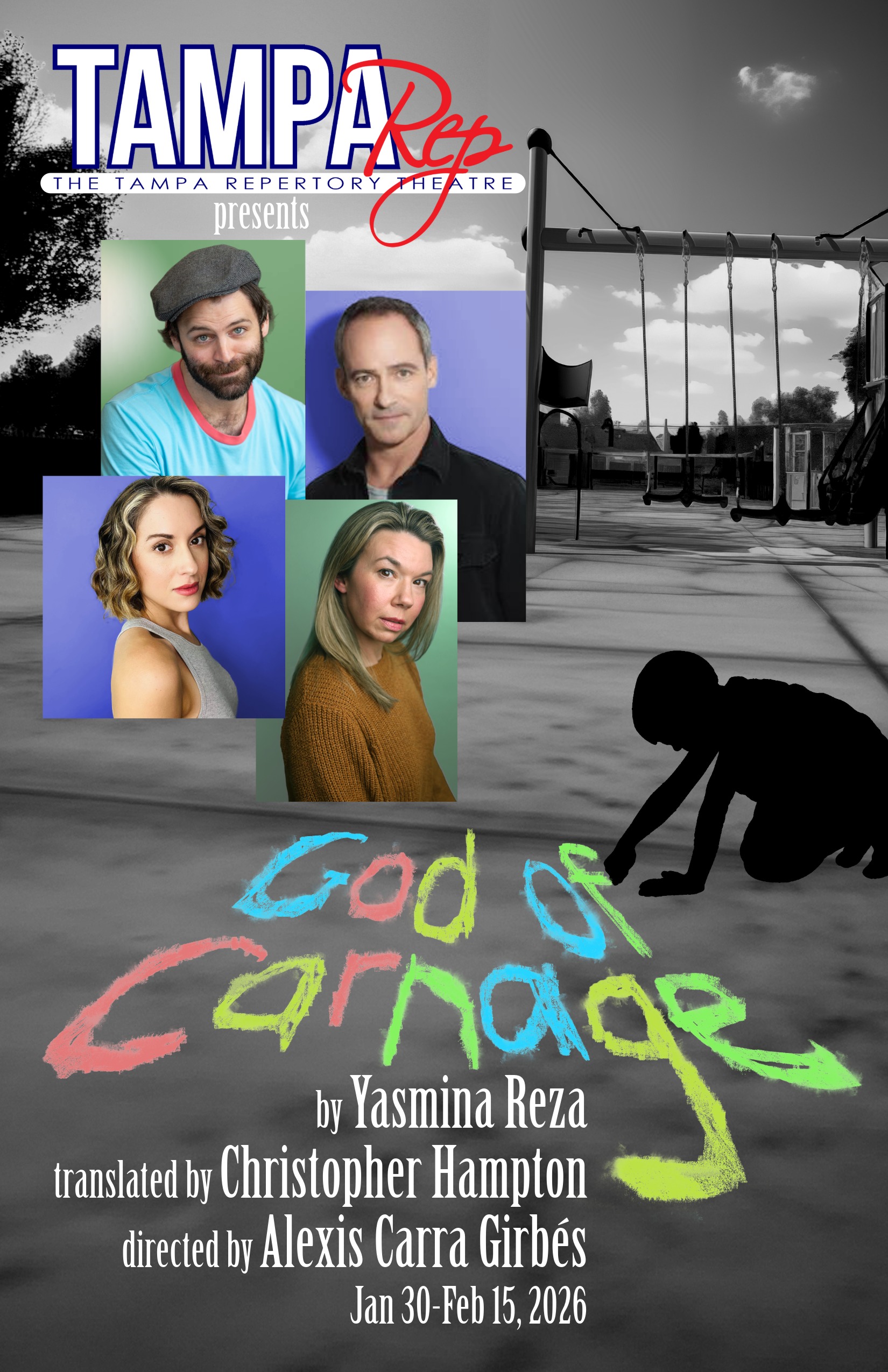
God of Carnage
by Yasmina Reza
translated by Christopher Hampton
director’s notes by Alexis Carra Girbes
I have always been fascinated by stories that explore the human condition. Humans are endlessly complex. Paradoxical, messy, tender, and often absurd. What I love about God of Carnage is how it exposes all of that at once–the darkness and the humor, the love and the cruelty, the very childlike behavior that lives just beneath our carefully constructed civility.
The “God of Carnage,” as Alan so aptly names it, lives inside all of us. In bringing this production to life, I was drawn to updating the world of the play to 2026, and staging it in the round—placing the audience uncomfortably close, without the safety of distance. There is no fourth wall to hide behind here. We watch these characters unravel from every angle, and in doing so, we become complicit. Like voyeurs, we are invited into a private moment we perhaps shouldn’t be witnessing, but can’t look away from.
What challenged and excited me most was finding the balance between light and dark, between brutality and comedy. I found myself laughing at moments of truth that border on absurdity because they feel so painfully familiar. These characters begin as polite, reasonable adults, but quickly regress, revealing the fragile, impulsive selves we all carry within us.
There is something deeply relatable about this play. We see ourselves in these archetypes. In their certainty, their defensiveness, their need to be right. And through that recognition, we’re given permission to laugh at ourselves. Especially in a time when violence feels increasingly present in our so-called civilized society, this play asks us to look inward. To confront our own contradictions. To examine the thin veneer that separates order from chaos.
And yet, beneath the savagery, there is still a question being asked. As Veronica suggests, perhaps we can try… try to believe in the possibility of improvement.
– Alexis Carra Girbés, January 2026